
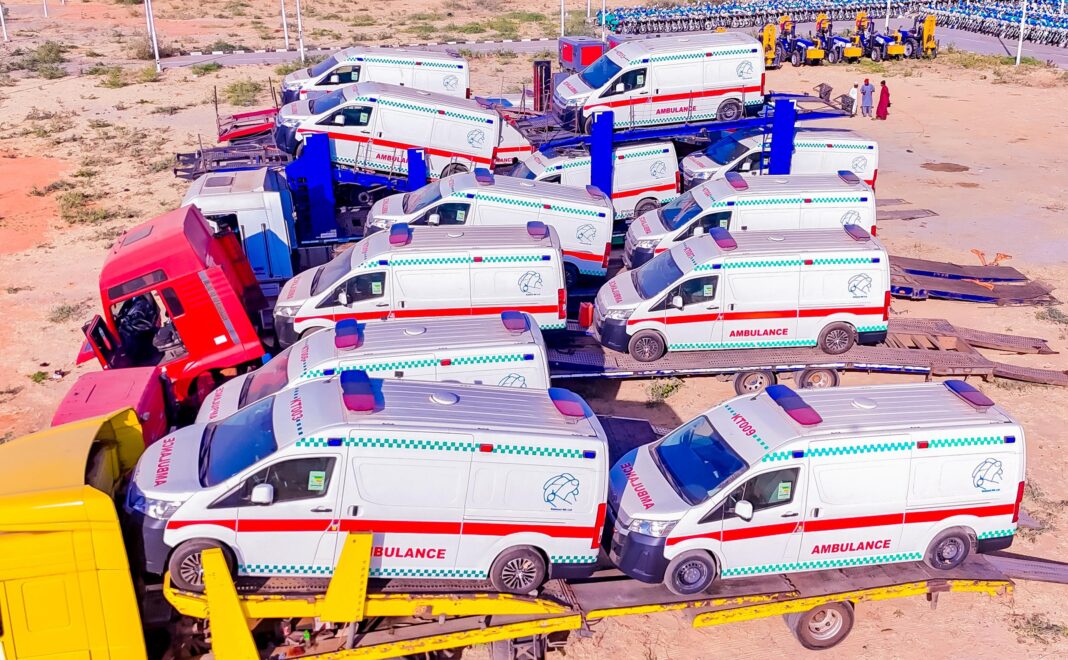

The Katsina State Government has taken delivery of 15 newly procured, state of the art Intensive Care Emergency Ambulances to kick start round the clock emergency healthcare services across the state, reinforcing its commitment to improved health delivery.
The arrival of the ambulances represents another milestone in the ongoing healthcare reforms under the administration of Governor Dikko Umaru Radda, aimed at strengthening emergency response and saving lives, especially in critical situations.
The procurement of the ambulances was approved by the Katsina State Executive Council at its 17th meeting held on November 22 last year, under the State Emergency Medical Services and Ambulance System, as part of efforts to institutionalise a functional emergency medical response framework.
Each of the ambulances is fully equipped with modern life support facilities including oxygen supply systems, patient monitoring devices, stretchers and resuscitation equipment, making them capable of stabilising patients in transit and responding effectively to accidents and disasters.
The vehicles were formally received at a presentation ceremony by the Chief of Staff to the Governor Abdulkadir Mamman Nasir, who described the development as another fulfilled promise of the Radda administration in its drive to prioritise the welfare of citizens.
Nasir explained that with ongoing construction of new roads and rehabilitation of existing ones across the state, vehicular movement is expected to increase, noting that government must also be prepared to address the higher risk of road accidents and related emergencies.
He stated that the ambulances would operate on a 24hour basis and be strategically stationed along major highways, densely populated areas and within communities, adding that with a simple emergency call, help should arrive within minutes to convey victims to the nearest health facility.
The Chief of Staff further disclosed that a coordinated management framework involving the Federal Road Safety Corps, the Ministry of Health and relevant local government authorities would be put in place to ensure effective deployment, as the ambulances are rolled out in phases across the three senatorial zones to improve response time and expand access to life saving care statewide.

