
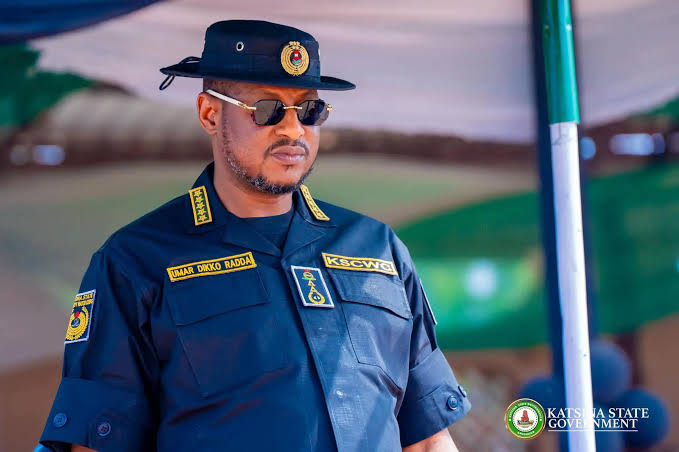

In the complex theatre of internal security management, success is rarely loud and victories are often misunderstood. Yet, across Katsina State today, quiet but measurable progress is unfolding. Progress born out of resilience, strategic leadership and tireless commitment by the administration of Governor Dikko Umaru Radda, working in close synergy with the Commissioner for Internal Security and Home Affairs, Nasiru Mu’azu Danmusa. In a state long scarred by banditry, mass abductions and rural displacement, the pursuit of peace has demanded courage beyond conventional governance and policies grounded in both firmness and empathy.
The recent controversy surrounding the proposed release of some suspects linked to banditry trials has once again brought Katsina’s security strategy into national focus. While public debate has been intense, what has often been missing from the conversation is a balanced understanding of the painstaking efforts, sacrifices and results recorded by the Katsina State Government in its determined fight to reclaim peace. Far from being a sign of weakness, the government’s approach reflects a mature, people centred and globally recognised conflict resolution model aimed at ending bloodshed and restoring normal life.
From the moment Governor Radda assumed office, security was declared a top priority. The administration inherited a deeply entrenched crisis that had festered for years, leaving communities traumatised and economic activities paralysed. Entire local government areas had become theatres of fear, with bandits dictating the rhythm of daily life. Rather than offering excuses, the new government immediately set out to confront the problem with a clear eyed understanding of its complexity.
Governor Radda’s security philosophy has consistently rested on the principle that no single approach can defeat insecurity. This understanding informed the adoption of a dual track strategy combining kinetic operations with non kinetic interventions. On one hand, the government strengthened collaboration with the military, police and other security agencies, providing logistical support, intelligence coordination and welfare assistance. On the other hand, it opened channels for dialogue where communities themselves indicated readiness for peace.
At the centre of implementing this delicate balance is the Commissioner for Internal Security and Home Affairs Nasiru Mu’azu Danmusa, whose role has been both demanding and critical. As the chief coordinator of internal security policies, the commissioner has worked tirelessly behind the scenes, engaging security agencies, traditional institutions, community leaders and affected populations. His calm but firm handling of security matters has earned him recognition as one of the key drivers of the relative stability now returning to several parts of the state.
The much discussed peace initiative involving frontline local government areas did not emerge overnight nor was it imposed by government fiat. It was the product of months of consultations, negotiations and confidence building measures led by community leaders who bore the brunt of violence. These communities, through their traditional leaders and elders, approached the government with a clear message, peace was possible if dialogue was given a chance. Governor Radda’s administration listened.
Under the supervision of the Ministry of Internal Security and Home Affairs, the government ensured that these peace engagements were structured, monitored and aligned with legal frameworks. Commissioner Nasiru Mu’azu Danmusa has repeatedly emphasised that the goal was not to legitimise criminality but to end hostilities, rescue captives and prevent further attacks. This position reflects a deep understanding of conflict dynamics, where the protection of innocent lives often becomes the most urgent moral obligation.
The results of this approach are difficult to ignore. Through the community driven peace accords, more than one thousand abducted persons have regained their freedom. These are not mere statistics, they are mothers reunited with children, farmers reunited with their land and communities reunited with hope. In Sabuwa, Bakori, Danmusa, Dutsinma, Safana and other local government areas, the release of captives has eased long standing trauma and restored confidence among residents.
Beyond the humanitarian gains, the peace initiative has translated into tangible socio economic recovery. Markets that had been shut for years due to fear of attacks are reopening. Farmers who once abandoned their fields are returning to cultivation and harvesting their produce. Rural trade routes are gradually becoming active again. These developments directly impact food security, income generation and social stability, key indicators of a functioning society.
It is within this broader context that the proposed release of some suspects linked to the peace agreements must be properly understood. Crucially, state authorities have clarified that those affected are not entirely hardened bandits actively involved in violent operations. Many of the suspects were arrested in the course of security sweeps for being relatives, logistical supporters or close associates of bandits, as part of the government’s broader strategy to smoke out criminal networks, dismantle support systems and apprehend principal actors.
According to Commissioner Nasiru Mu’azu Danmusa, this distinction is vital. The proposed releases are tied to verifiable conditions agreed upon by communities and armed groups to sustain peace, recover arms, free captives and isolate unrepentant criminals. Such measures, he explained, are carefully considered confidence building steps and do not amount to blanket amnesty or abandonment of justice. Globally, negotiated releases and conditional disengagements have played key roles in resolving prolonged conflicts, including within Nigeria’s own security history.
What further distinguishes Katsina’s approach is the level of institutional caution applied. The Ministry of Justice, the courts and relevant oversight bodies are involved to ensure that due process is observed and that individuals implicated in direct acts of violence face appropriate legal consequences. Governor Radda has consistently insisted that security decisions must operate within the ambit of the rule of law, even when urgency demands flexibility.
Importantly, the administration has not relied solely on peace initiatives. Kinetic operations have continued decisively in areas where dialogue has failed or where criminal elements remain defiant. Security agencies have recorded successes in dismantling bandit camps, intercepting weapons and rescuing victims. This clearly demonstrates that dialogue is not a replacement for enforcement but a complementary tool deployed strategically.
Commissioner Nasiru Mu’azu Danmusa’s role in coordinating these parallel efforts cannot be overstated. His constant engagement with security commanders, judicial authorities and community stakeholders has helped prevent policy contradictions and operational gaps. At a time when misinformation spreads rapidly, his clear communication has been vital in explaining government actions and managing public concerns.
Governor Radda’s leadership style has also played a crucial role in sustaining momentum. His consistent consultations with traditional and religious leaders, as well as civil society groups, have reinforced a sense of collective ownership of the peace process. By decentralising responsibility and empowering communities, the administration has strengthened trust at the grassroots.
Peace building is rarely linear. Setbacks, criticisms and misunderstandings are inevitable. However, reducing Katsina’s comprehensive security efforts to a single controversial decision ignores the wider picture of sacrifice, strategy and progress. The lives saved, communities stabilised and economic activities restored remain powerful evidence of a government focused on results rather than rhetoric.
For families who have endured months or years of fear and uncertainty, the return of loved ones outweighs abstract arguments. This reality does not negate the need for justice. Rather, it highlights the importance of empathy and context in evaluating security policies.
In the final analysis, the tireless efforts of the Katsina State Government under Governor Dikko Umar Radda, supported by the strategic leadership of Commissioner Nasiru Mu’azu Danmusa, reflect a clear commitment to securing peace through lawful, humane and pragmatic means. Their approach recognises a simple but powerful truth, lasting peace is achieved not by force alone but by the courage to combine dialogue, justice and humanity. In a state that has endured deep pain, that courage deserves understanding, support and sustained cooperation.

